Plums
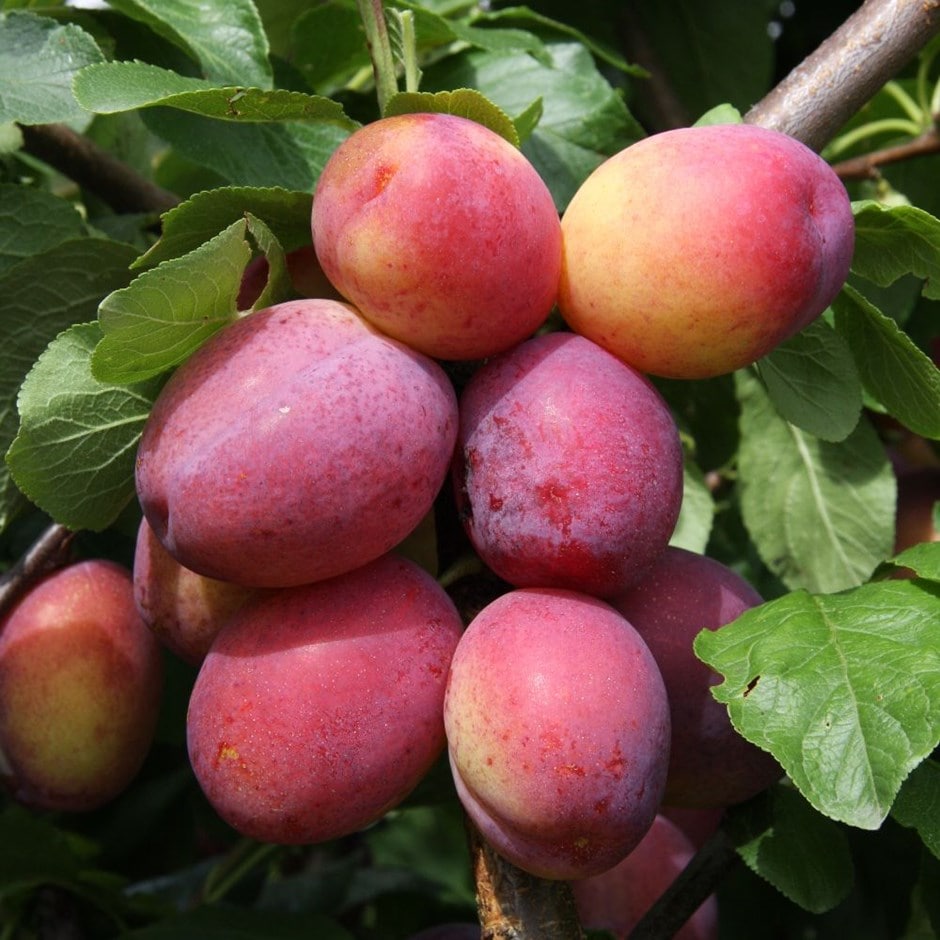
Victoria
Could this be the best pollinator of them all?
At the very least, it is difficult to grow plums commercially without developing a fairly close relationship with Victoria.
This old English variety dates back to the 19th century and was named after Queen Victoria. After all those years, the name has become so familiar that, for many people, Victoria is almost synonymous with plums.
A little like Van and sweet cherries.
To some people, every plum is a Victoria.
It isn't, of course.
But Victoria has qualities that have kept it firmly planted in Norwegian orchards. Most importantly, it is an extremely useful pollinator, which is why we plant Victoria trees here and there among rows of other varieties to help the rest of the orchard do its job.
And Victoria itself?
It certainly doesn't need much encouragement to produce plums.
This is the yield machine of our plum orchard. Year after year the trees are loaded, and when measured by sheer number of fruits, it is difficult to imagine many varieties competing with it.
The problem is that the tree hasn't necessarily read the commercial requirements for fruit size.
If we want large, attractive Victorias, we may have to remove something approaching nine out of every ten fruits. That sounds absolutely brutal when you're standing in front of a tree covered in plums and deliberately throwing most of them onto the ground.
The alternative, however, is approximately one million plums the size of marbles.
As an eating plum, Victoria is perfectly respectable. Properly ripe, it tastes good, although several of our other varieties quietly sneak past it on the flavour scale. For preserving and processing, however, Victoria has been a household favourite for generations.
And in some years, Victoria gets to become the star itself.
When frost, poor flowering or other conditions have reduced the crops of other varieties, you can still look at Victoria and wonder whether anyone actually told it that this was supposed to be a bad plum year.
In those years, we have no trouble selling Victoria for fresh eating either.
So Victoria isn't necessarily in our orchard because it is the finest plum we grow.
It is here because it always turns up for work – while helping its neighbours do the same.
Queen Victoria is long gone.
The Victoria plum, however, appears to have no intention of retiring.
- Old English variety from the 19th century, named after Queen Victoria
- One of the most important pollinating varieties in our plum orchard
- Exceptionally productive – a crop every single year
- Probably our highest-yielding variety when measured by number of fruits
- Requires very heavy thinning to achieve good fruit size
- A perfectly good eating plum when properly ripe
- Traditionally very popular for preserving and processing
- Planted among our other varieties primarily for pollination
- Particularly valuable in years when other varieties produce poor crops
- So famous that, to many people, “every plum is a Victoria”
- It has been around for so long that it almost feels as though humanity has always had Victoria