Technology should solve problems – not create new ones
Modern farming involves far more than tractors, machinery and fruit trees. People need to be in the right place, work has to be planned, crops recorded, water and nutrients delivered to plants, and large amounts of information preserved throughout the season.
Many of the solutions we needed already existed, but often as separate systems with limitations, subscriptions, manufacturer lock-in or a price that was difficult to justify on an ordinary farm. So we started building our own.
The result is a collection of systems developed from practical needs in everyday farming. Each can work independently – but their real strength appears when they work together.
Irrigation when the plants need it – not simply when the clock says so
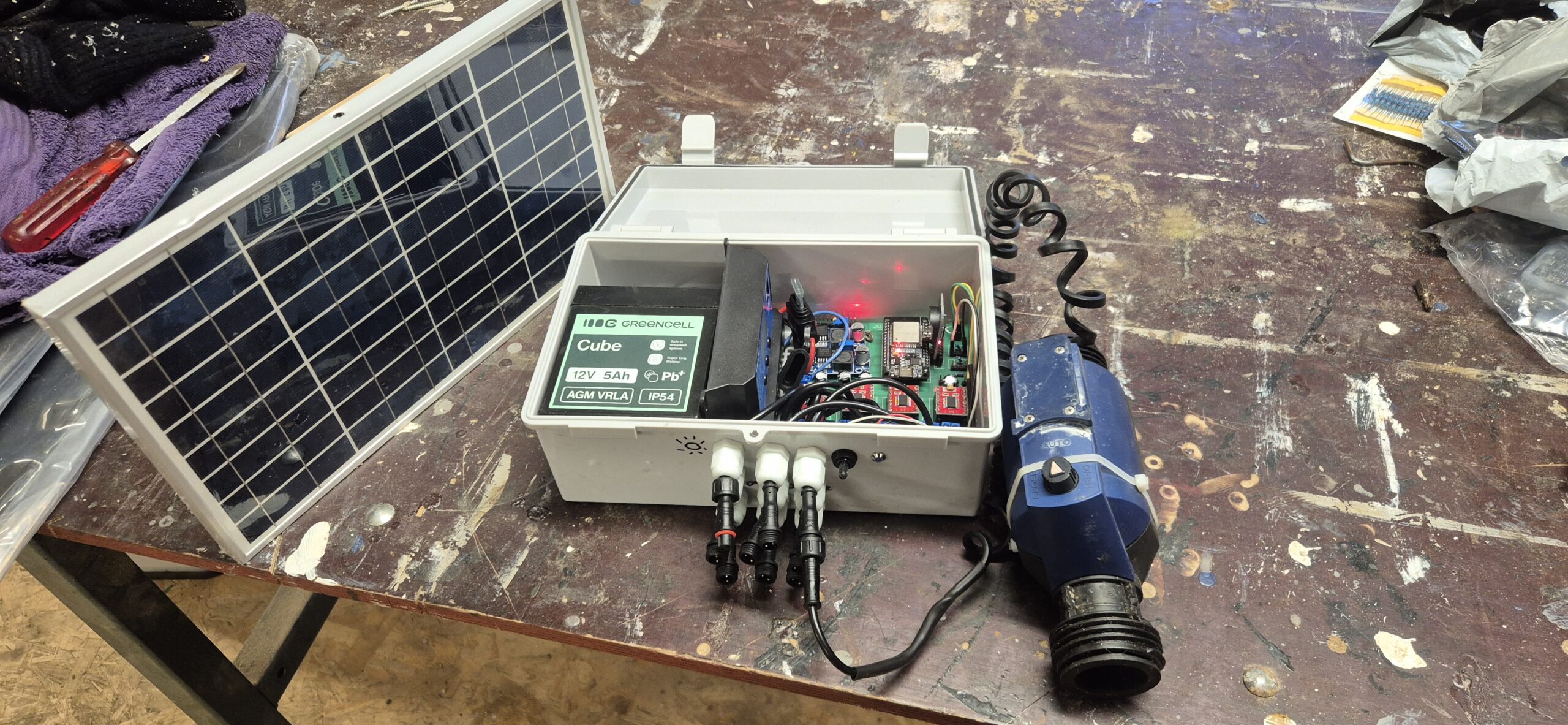
Sif X is our own irrigation computer and the part of our technology that interacts directly with the physical farm.
Traditional irrigation can be as simple as a timer opening a valve at a predetermined hour. It works – but plants do not live by a clock. Their requirements change with temperature, humidity, sunlight, rainfall, growth stage, growing medium and the water they have already received.
Sif X can control irrigation zones and valves, run programmes for different crops and fields, and automate irrigation while treating very different parts of a farm individually. In intensive growing systems, precision can be critical.
The objective is not necessarily to use more water. It is to use the right amount of water, in the right place, at the right time. That provides better control, reduces unnecessary resource use and enables more advanced growing systems. New sensors, functions, control strategies and integrations can be added as requirements evolve.
From the first strawberry to the final apple
Harvest began with a simple question: how much have we actually harvested? On a fruit farm, the answer quickly becomes complicated. Produce may go to a packing station, direct sales, processing or storage. Some is repacked, some is lost, and different varieties ripen at different times.
Harvest brings together harvesting, direct sales, deliveries, stock, repacking and other movements of produce through the farm. The aim is to follow a crop from the moment it is picked until it leaves the farm – and account for where every kilogram went.
At the same time, the system builds history. With several seasons recorded, varieties, fields and years can be compared, and production can increasingly be viewed alongside weather, temperature and other conditions. Harvest then evolves from a digital harvest log into a tool for understanding production itself.
Working hours without paper, lists and guesswork
During the busiest part of the season, many people may be working at the same time, often in different fields and on different jobs. Timereg is our system for recording working hours.
Workers check in when the day starts, register breaks and check out when the working day is finished. It is designed to be fast and simple enough for a screen in a real working environment – not just an office.
For administration, it provides an overview of hours, working days and workplaces. And when labour data can be viewed alongside tasks and production, it becomes possible to understand how much work a field, crop or season actually required.
From “what am I doing today?” to a plan everyone can see
A farm rarely suffers from a shortage of jobs. The challenge is deciding what should be done first. Workplan is designed for planning and following up work on the farm.
Tasks can be linked to fields, rows or working areas and assigned to the people responsible. For a worker, it should be simple to see what is on the plan. For the person organising the work, it should be equally simple to see what is complete, what remains and what needs attention next.
Tasks can be documented with photographs and comments and followed up or approved when completed. Workplan can therefore become the link between planning, completed work, recorded labour and production results.
The system that looks after the systems
Once several digital systems become part of daily operations, another problem appears: someone has to look after them too. MSM – Morellmannen Server Manager – was developed for exactly that purpose.
MSM brings administration, status, backups and maintenance together in one place. Instead of treating every application and service separately, it provides an overview of the farm's digital infrastructure.
It maintains local and off-site backups, keeps track of services and helps make problems visible. It is probably the part of our technology you notice least when everything works – which is exactly how it should be.
Independent systems – or parts of something bigger
Sif X, Harvest, Timereg, Workplan and MSM solve different problems and do not depend on each other. A farm can use only the system it needs.
But they are designed with the possibility of working together. Workplan can know what work should be done. Timereg can tell us how much labour was used. Harvest can show what the farm produced. Sif X can control and document an important part of the inputs behind production. MSM can look after the infrastructure keeping it all running.
Bring the information together and the result becomes more than five separate applications: it begins to create a digital picture of the farm. That opens the door to relationships between labour, weather, irrigation, fields, varieties and yield – and eventually to using accumulated history to make better decisions about tomorrow.
Interested in one of the systems?
The systems are developed and used in daily operation on our farm. Some can be installed as standalone systems, while others can be combined into larger solutions. Direct downloads are not open yet – please get in touch if you would like to know more about use, adaptation or available versions.
Get in touch →None of these systems began as software for software's sake. They began because we had a problem we wanted to solve.
Farming will always be about soil, plants, weather and people. Technology is not there to replace that. It is there to help us understand it better.