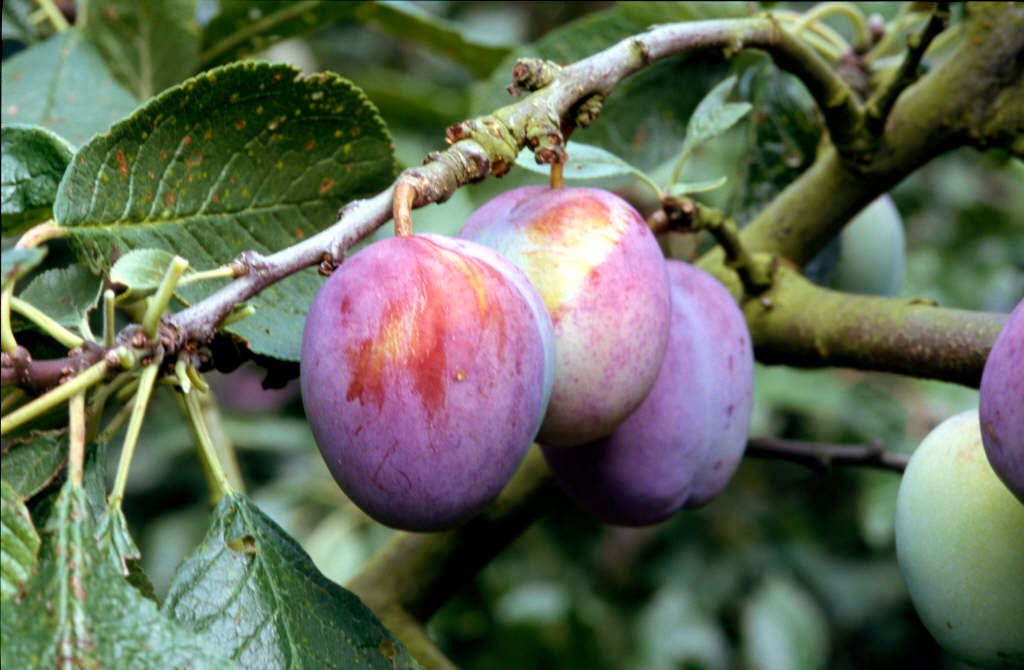
Plums
Mallard
Was Mallard named after the English duck – with its rather impressive collection of colours? Or is there some entirely different historical connection that we simply haven't discovered yet?
Good question.
What we do know is that Mallard is an old English plum variety with a history stretching all the way back to the 18th century. The story goes that the variety was discovered more or less by chance.
But after tasting a perfectly ripe Mallard, you begin to question that part of the story.
Could something this good really have been an accident? Or was there an exceptionally talented gardener somewhere in 18th-century England who knew exactly what was required to create the perfect plum?
Because Mallard comes very close.
Very close.
The flavour is in another league. Intense, sweet and complex, with the kind of balance that means you don't simply eat one plum and walk away – you take another. And probably another after that.
This is quite simply the plum of plums.
The fruit is medium to large, the texture is superb, and when properly ripe the stone separates easily from the flesh. The trees produce good crops, and once Mallard is ready for sale, production isn't necessarily the biggest challenge.
Having enough of them is.
This is one of those plums people come back for, and some are more than willing to queue when they know Mallard is ripe.
The variety does have its little challenges. It can be somewhat susceptible to plum pocket disease, which isn't exactly something we ask for.
On the other hand...
When the tree is producing plenty of fruit anyway, perhaps we can call it biological thinning and pretend it was all part of the plan? :D
Mallard is old. Properly old.
But even though it dates from the days of “bows and arrows”, it can still hit today's taste buds straight in the heart.
- Old English variety with a history stretching back to the 18th century
- Mid-season
- Medium to large fruit
- Fantastic sweet, complex flavour and superb texture
- The stone separates easily from the flesh when ripe
- Good yields
- Extremely popular – this is a plum people come back for
- Somewhat susceptible to plum pocket disease – or biological thinning, if we want to stay positive :D
- The plum of plums
- From the days of “bows and arrows” – and still hitting today's taste buds straight in the heart