Sweet cherries
Coe’s transparente
There was a time when Coe's Transparent was a fairly common sight in the orchards of Hardanger.
The variety has its roots in USA, where it is said to have originated with Curtis Coe sometime before the middle of the 19th century. It took his name and eventually spread to fruit growers far beyond its homeland. In time, it also found its way to Hardanger, where it became an important part of the early sweet cherry season.
And it is easy to understand why people liked it.
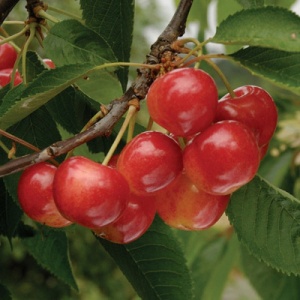
Coe's Transparent is a very early yellow cherry with beautiful red cheeks and a sweet, appealing flavour. When the first fruit begins to ripen, it provides a rather effective reminder of what we have to look forward to over the coming weeks.
There is just one problem.
The flesh is extremely soft.
This is almost the definition of a cherry that should be eaten straight from the tree. It tolerates handling, storage and transport poorly, and as the requirements of commercial fruit distribution changed, Coe's Transparent was eventually phased out as a commercial variety towards the end of the 1980s.
Today, we have just one old tree remaining in the farmyard.
And that tree still has an extremely loyal customer base.
Unfortunately, the customers have wings.
Blackbirds and fieldfares appear to be in complete agreement that Coe's Transparent is still a world-class cherry. As soon as the fruit begins to ripen, they arrive in numbers, and the competition between Morellmannen and the birds to discover the ripe cherries first is fierce.
The birds usually win.
I barely manage to get hold of a few perfectly ripe cherries before the rest disappear.
But the few I do get?
They still taste wonderful – and through one solitary old farmyard tree, a small piece of Hardanger's sweet cherry history lives on.
- Exceptionally early variety
- Yellow with beautiful red cheeks
- Sweet and very good flavour
- Good yields
- Extremely soft-fleshed – best eaten straight from the tree
- Poorly suited to storage and transport
- Once an important variety in Hardanger – today we have just one old farmyard tree left
- Extremely popular with blackbirds and fieldfares
- The birds usually win the battle for the crop