Sweet cherries
Lapins
If you had to name one dominant variety in Norwegian sweet cherry production, it would be very difficult to look beyond Lapins.
It is by far the most widely planted variety in Norway, with around nine out of ten Norwegian sweet cherry trees having been reported as Lapins. That sounds almost absurd – until you see what this variety is capable of.
Because in some years, Lapins is the undisputed Norwegian champion of yield.
The trees can carry such extraordinary quantities of fruit that branches can quite literally break under the weight. In those years, there is nothing for it but to grit your teeth and start thinning, no matter how painful it feels to pull off large quantities of seemingly perfect cherries.
And there are two good reasons for doing it.
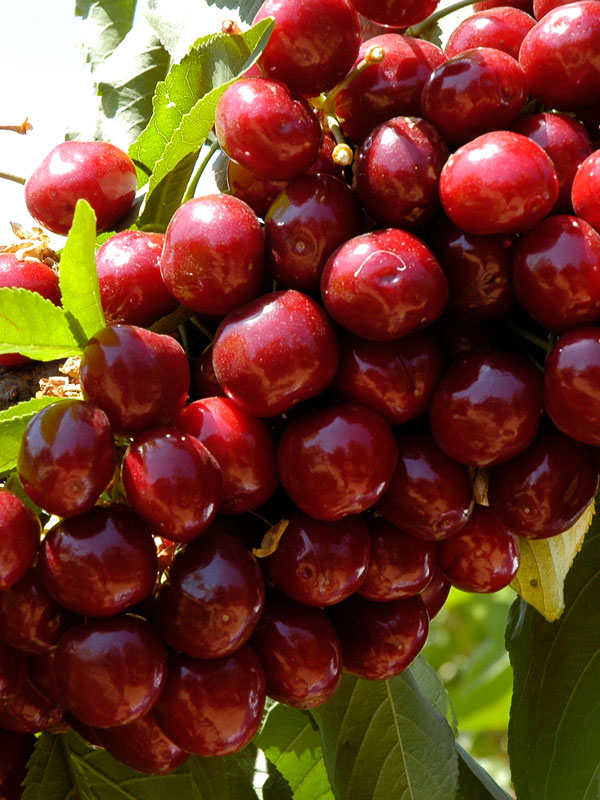
When the crop load becomes excessive, the cherries remain smaller. At the same time, densely packed clusters create exactly the kind of humid conditions fungal diseases enjoy. Fewer cherries can therefore mean much better cherries – and healthier fruit.
That extraordinary productivity is undoubtedly one reason why Lapins has become so dominant among Norwegian growers. Much of the crop also ripens within a relatively concentrated period, making it a highly efficient variety for commercial production.
And the cherries themselves are certainly no disappointment.
When allowed to remain on the tree long enough, Lapins develops excellent flavour. The fruit is medium to large, juicy and firm, with a distinctly crisp bite that places it among the crunchier varieties we grow.
Lapins has another major advantage as well: it is self-fertile, while also being an important pollinator for numerous other sweet cherry varieties.
And that is actually its main job on our farm today.
We no longer have many Lapins trees, but the few we retain have an important role as the “father” of our rather diverse cherry population. With so many different varieties around the farm, reliable pollination matters – and Lapins is an extremely useful fellow to have standing among them.
The story behind the variety is interesting too. Lapins was developed in Canada by Karlis O. Lapins, a Latvian-born fruit breeder who settled in Canada and became an important figure in the development of modern sweet cherries, particularly self-fertile varieties.
And then there is the name.
Lapin happens to mean rabbit in French.
Considering what these trees can do in a heavy cropping year, it is tempting to wonder whether the name was more appropriate than anyone realised.
Breeding like rabbits...
- By far the most important and widely grown sweet cherry variety in Norway
- Can produce extraordinary yields in some years – thinning then becomes essential
- Crops can become heavy enough for branches to break under the weight
- Mid-to-late season variety with a relatively concentrated harvest
- Medium to large fruit with excellent flavour when allowed to ripen fully
- Firm with a distinctly crisp bite
- Self-fertile and an important pollinator for many other varieties
- Developed in Canada by Latvian-born fruit breeder Karlis O. Lapins
- On our farm, its main job today is being the “father” of our cherry population
- And yes – lapin means rabbit in French. Breeding like...